























































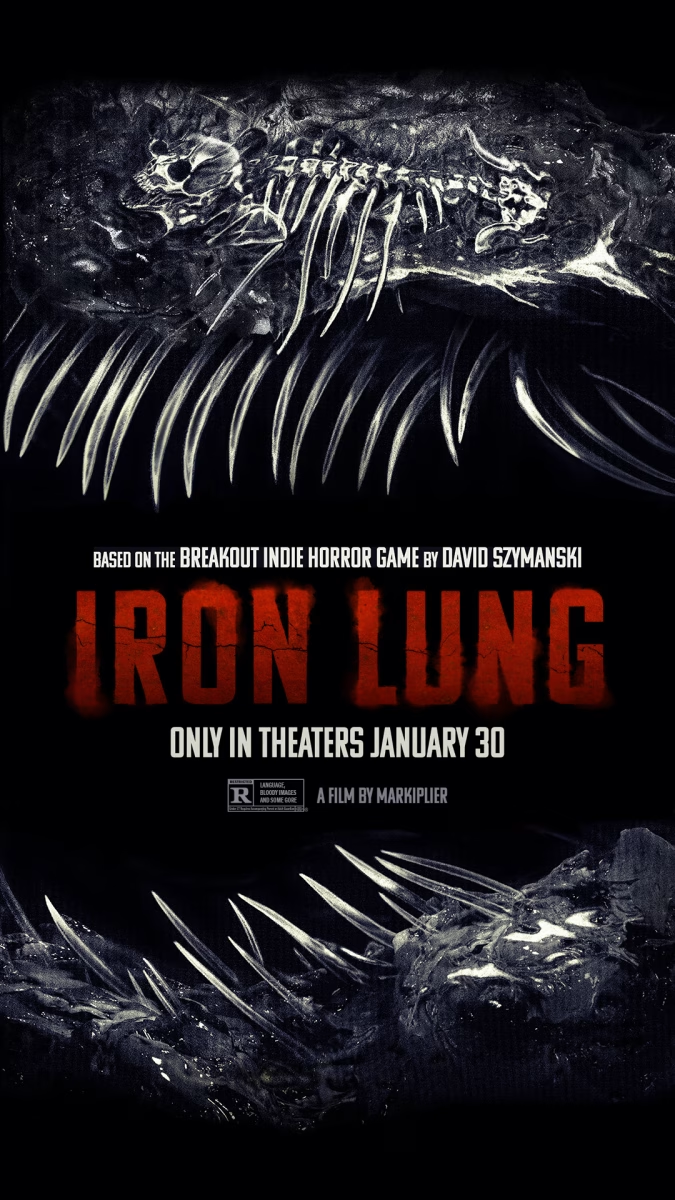
Every now and then, I get it into my head that I just don’t enjoy movies as a medium. I decide that they aren’t conducive to good stories—that they’re too long or too short, too garish and too tropey. I start thinking all of them have the same bland texture, smooth enough to be tolerated but with an aftertaste that irks. And then I watch a movie like Iron Lung, and remember that joy and peace still exist in this world.
For the unfamiliar, Iron Lung is a sci-fi horror film based on the game of the same name, directed, produced, and funded by the YouTuber Markiplier. He also plays the main character, a convict named Simon. Almost all of it takes place within the minuscule set of a submersible that Simon must use to navigate an ocean of blood, hunting for information that could be used to figure out why the stars and planets have disappeared. This event was termed the Quiet Rapture, and, along with various celestial bodies, also vanished most of humanity, condemning the few who survived on space stations to a slow, creeping death. (This article won’t get into more spoilers than that, so feel free to keep reading whether you’ve seen it or not!)
It’s not a movie that one would expect to be as good as it is—no matter your opinions on Markiplier, you have to admit that ‘YouTuber movie’ is not a phrase that inspires confidence. Honestly, he probably could have phoned it in and a good portion of viewers would still walk away happy.
He did not phone it in at all. I say this as someone who is honestly a fake Markiplier fan and knows nothing about the game: this movie is one of the best I’ve seen in a very long time. It is fighting it out with Benoit Blanc movies in my rankings, that’s how good it is.
It stands on its own two feet and comes out swinging, with maybe two minutes of exposition before you’re plunged into the blood ocean along with Simon. From there, Iron Lung assumes the slow, methodical pace it maintains for most of the movie, and then abandons once you hit the point in the film where you learn where the record-breaking fake blood usage came in.
The movie runs a brisk two hours and seven minutes, but it doesn’t feel like it. The honey-slow pacing draws out each moment like taffy, but still manages to move things along before they snap. It doesn’t drag, it lingers. Iron Lung, despite (or perhaps because of) the urgency of Simon’s situation, doesn’t rush itself. The worldbuilding is sparse, but it doesn’t make the film feel empty—on the contrary, the experience is much closer to seeing an iceberg pass by. You get this unshakable feeling that you’re only seeing a fragment of a wider whole. You have just enough to understand the movie, but there are enough questions left unanswered to keep the sense that a wider universe really is out there, and similarly to real life, it’s impossible for us to see all of it.
This feeling is further enhanced by how constrained it is—small set, tiny cast, and a budget of $4 million in an age where half the films it was beating in the box office were spending well over ten times that amount. Those limits are part of the reason Iron Lung excels—the movie knows exactly what it is trying to do, and because it is doing only that, it does it exceedingly well. There’s so much loving detail in every technical part of the film—the sound, set, lighting, and costume designers all deserve freaking medals—which could really shine through on a small scale.
Additionally, the acting is phenomenal. The supporting cast is absolutely marvelous, and Caroline Kaplan demolished. (Also, shout-out to jacksepticeye for appearing on screen for at most three minutes and being implied to die by the end of film from radiation poisoning.) But they really are just that—supporting. The majority of the movie is a whole lot of Markiplier, who has managed to do what many other famous faces cannot: deliver a performance that genuinely immersed me in the character rather than just playing himself. Simon feels distinct and deeply human. He reacts to all the horrors the blood ocean has to offer in a remarkably relatable and humorous way, making his more emotional moment all the more impactful. He makes jokes and mistakes, lashes out, apologizes and tries, constantly, unceasingly. And that persistent effort, above all else, is what shapes the movie.
Iron Lung is, at its core, not about the end of the world. It’s about moments right before. It’s about the people bracing for impact. It’s about the people still scrambling for solutions. It’s about the tangled threads of hope and desperation and how neither of those are virtues, but neither could ever be called a fault. It’s about the human urge to reach out even when we have no hands. It’s Markiplier getting bodily launched around a box for two hours. It contains multitudes.
I went to watch Iron Lung during one of the most stressful weeks of my life, and if it wasn’t for the fact that my friend and I had been planning to see it together literally since it was announced, I probably would have cancelled. I’m so incredibly glad I didn’t. It is absolutely worth the time, and I would highly recommend seeking it out in theaters or keeping an eye out for news of any digital or physical releases.