


























































In the late 2000’s, there was an increasing demand for life simulation games. EA had created The Sims, and Nintendo found itself lagging behind as it scrambled for an brand-specific alternative.
Initially released for the DS, Tomodachi Collection introduced the concept of taking care of and interacting with Miis. The idea was based on the then-popular “tomogatchi” toys, and the game quickly became a hit in Japan. Then, in 2013, Tomodachi Life was released for the 2 and 3DS, featuring more advanced graphics and more features. Tomodachi Life would go on to be one of the most popular games for the 3DS.
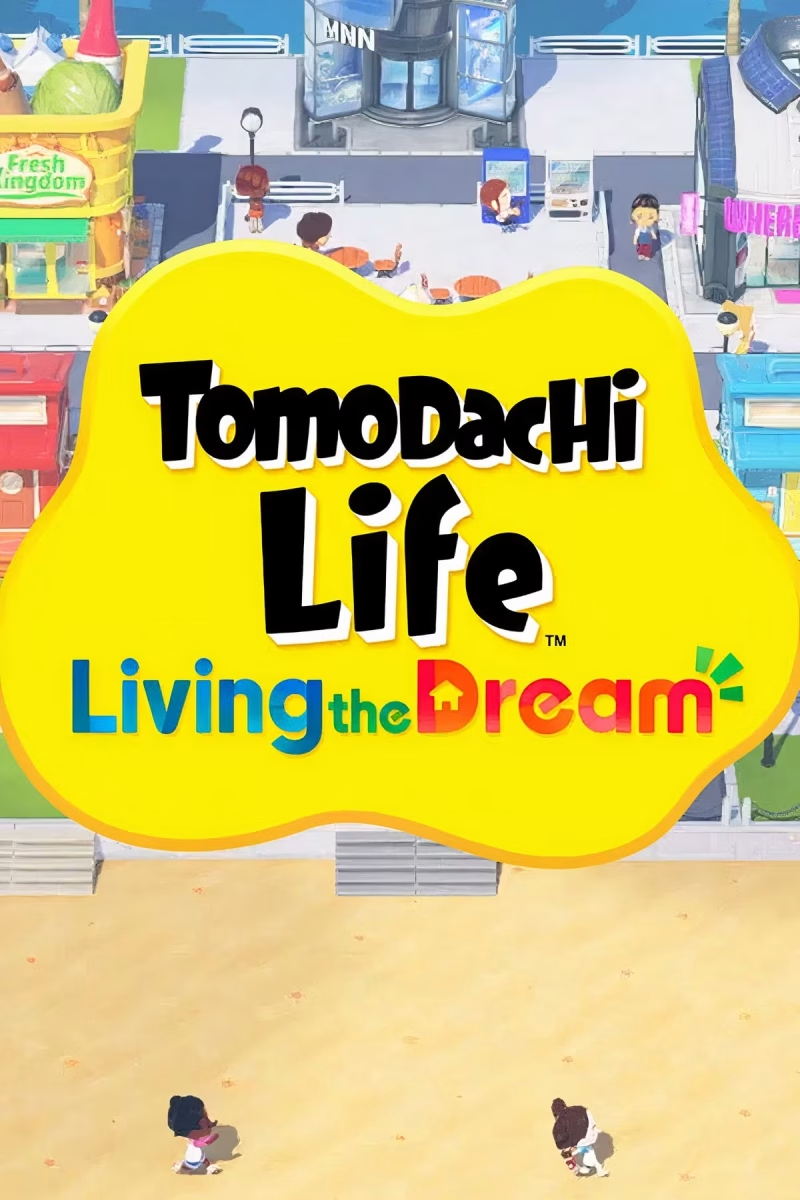
After twelve long years without a new game, a new Tomodachi Life game was finally added to the franchise. The addition, titled Tomodachi Life: Living the Dream would be available on both the Switch and Switch 2 on April, 16th, 2026.
Upon opening the game, Living the Dream has most of the same qualities of the first games, and has added many more. In Tomodachi Life, Miis were completely autonomous except for when they asked you for advice. Crucially, you couldn’t really control who they became friends with or where they went. In the new game, you’re able to pick up Miis, move them around, and force them to interact with each other. Desperately trying to make certain Miis meet each other was one of the most frustrating aspects of the last game, especially if you were trying to encourage two characters to date.
With that change comes the ability to move your Miis to different locations. You can force your Mii out of the house at any time and make them do pretty much anything. I’ve had a lot of fun trying to throw my Miis into the ocean. You can make them go to the cafe, beach, lighthouse, or even just stare at the grass. If you want, you can even make an island to strand certain Miis on just off the shore of your usual island, and they won’t be able to get back! It’s a super useful feature that makes it feel less like you’re some creep just watching their lives, but instead like you’re a creep who has an active role in how they go about their day.
Additionally, Mii relationships have been majorly upgraded. The “best friend” category, which was formerly reserved for one Mii, has been removed. Now, your Mii can have many people who are their “best friend” or “ultra friend”, with “ultra friend” being the closest possible type of friend in the game. An even bigger upgrade is that when two Miis have reached at least the “best friend” relationship status, one of them can request to move in together, something that was only possible after marriage in the first game. This feature would have been especially helpful in Tomodachi Life, as same-sex relationships were illegal.
However, there’s no need to have two gay Miis move in together and pretend they’re married in Living the Dream, because same-sex dating and marriage are both fully allowed! When choosing the character’s gender, there’s an additional screen to choose dating preferences, with the options being “Male”, “Female”, or “Non-binary”. Even better, you can choose as many or as few of those options as you’d like. If you decide to make your character non-binary, a screen will pop up allowing you to choose which pronouns you’d like to be called. Despite this leap in inclusivity, the non-binary option isn’t available in certain languages, apparently due to those languages using binary-gendered adjectives.
The character creation has just generally improved in this new game. In Living the Dream, there are over fifty potential skin colors to choose from, as opposed to Tomodachi Life only having five. Along with that, there are thousands of potential hair options due to the fact that you can individually choose what the back of the hair and the bangs look like. There are many more mouth, nose and eye options, all of which can be moved around on the face.
Despite all of these positives, there are still a few drawbacks.
Living the Dream’s cost is the biggest drawback. $59.99 is a bit outrageous for a game in a franchise that’s been so neglected, especially considering that a few years ago you could easily buy both a Nintendo 3DS and a copy of the original Tomodachi Life and still have money left over to replace the 3DS stylus that you lost.
Even though Nintendo games have begun to cost upwards of $70, asking for so much money for a game that’s functionally a remake is more related to Nintendo being greedy as opposed to actual value. When Tomodachi Life was released, it was initially priced at $34.99, but was very soon after reduced to $19.99. With any luck, that’s what will happen to Living the dream.
A lot of very beloved features have been removed with this price increase, as well. The Music Hall, which allowed users to put on a concert with their Miis and customize the songs they were singing, is nowhere to be found. The same is true for most major mini-games, like Tomodachi Quest, Quirky Questions, and Judgement Bay. Similarly, the compatibility tester and rankings board have been left behind.
For many people, these features are what drew them to the game. They also served the important functions of allowing users to kill time while they were waiting for their Miis to need their help again. The only building reminiscent of these that was transferred to Living The Dream is the Photography Studio, which struggles to be as fun or serve the same purpose.
Living The Dream undoubtedly isn’t worth buying a switch for, nor is it necessarily worth almost $60. Despite this, it improves on most of the frustrating features of its predecessors and is a solidly good game. Even though certain features are removed, people who never experienced them won’t necessarily miss them. Generally, people playing this new game will feel like they’re Living The Dream.