


























































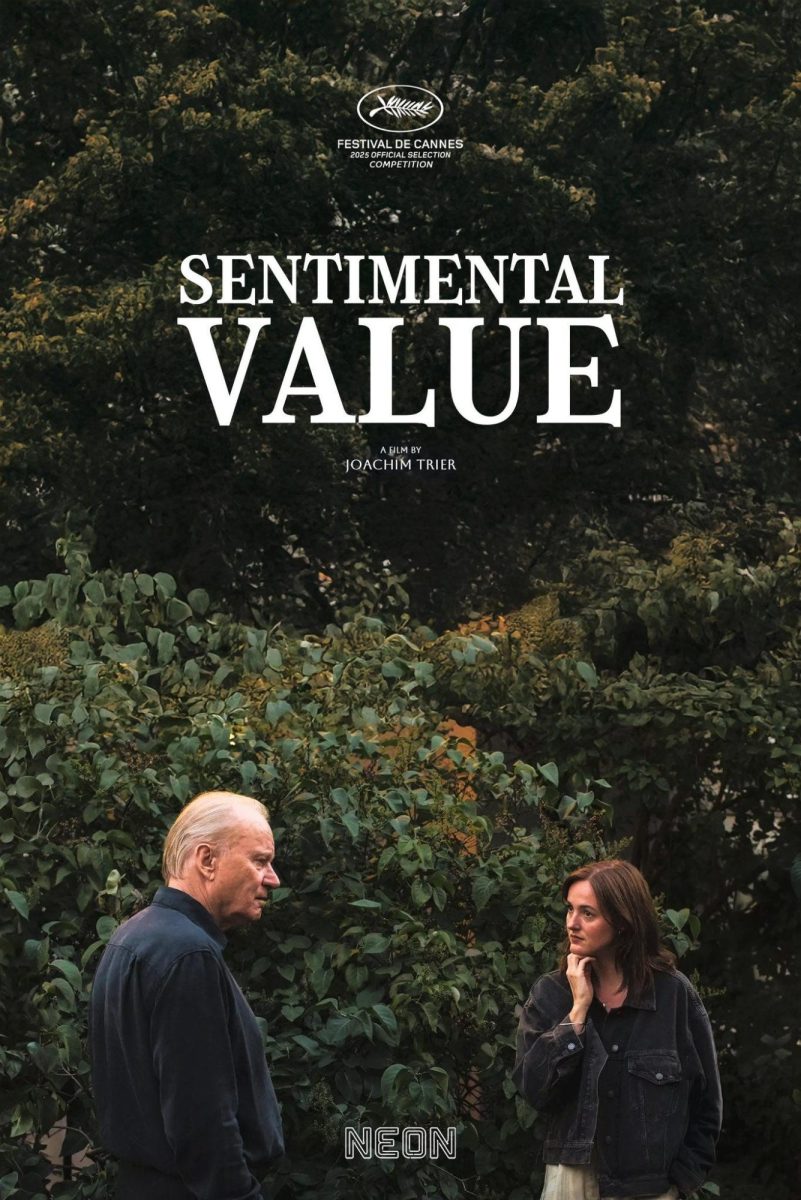
It’s been a while since I’ve watched a really good movie, let alone one that made it to my Letterboxd top four. Some might say this movie was overhyped, especially after winning the Grand Prix at the 2025 Cannes Film Festival and Best International Feature Film at the 98th Academy Awards, but Sentimental Value left me thinking for a while. Also, Norway is so beautiful and the house this movie is centered around is so gorgeous.
Sentimental Value is centered around a dysfunctional family and a house. Set in Norway, Gustav Borg is a movie director who has somewhat fallen off of creating well-known films. He had previously been married with two daughters, Nora and Agnes, but divorced their mother when they were young. He moves away and Nora, Agnes, and their mother live in Gustav’s family home for many generations. Years later, Nora is a theater actress and Agnes is a wife and mother, but when their mother passes away, Gustav enters their lives again.
The relationship between Gustav and his daughters is obviously strained, but that relationship gets worse when Gustav asks his older daughter, Nora, to star in a film about his mother, who committed suicide in their family home when he was a child. Nora, angry that her father has been absent in their lives for so many years and suddenly returns to ask her to be in his film, leaves without reading the script.
Without Nora on board, Gustav asks Rachel Kemp, a famous American actress, to star as his mother in the film. Rachel enthusiastically agrees, but soon realizes after talking to Nora that she isn’t the right person to star in this film. She doesn’t speak Norwegian, and it’s obvious to her that the character she plays was written for Nora, not her. After leaving the production, Gustav relapses into drinking and is hospitalized.
Meanwhile, Nora and Agnes are both not speaking to their father. Gustav fails to show up to Nora’s performances, and tries to cast Agnes’s son, Erik, in the film without asking her. However, Agnes decides to read Gustav’s script, and is moved by how accurately the character of Gustav’s mother depicts Nora and her depression. Nora and Agnes have an emotional meeting where Agnes asks Nora to read the script, and they have the most beautiful sister moment ever. Nora wonders why she ended up as the messed up sibling while Agnes turned out normal with a happy family, and Agnes tells Nora that the only difference in their childhoods was that “I had you.”
In the end, Nora and Agnes make up with their father, and Nora agrees to star in his film.
I just love how accurately this movie portrayed family relationships and emotions. I absolutely love the scene between Nora and Agnes (Agnes’s quote will stick with me for a long time), and each scene was super aesthetically pleasing. As an aunt, I loved the dynamic between Agnes’s son, Erik, and Nora, and I found something endearing in almost all the characters. I highly recommend this movie if you’re looking for a chill but moving film to watch, and I think it would be super healing to watch with family.