















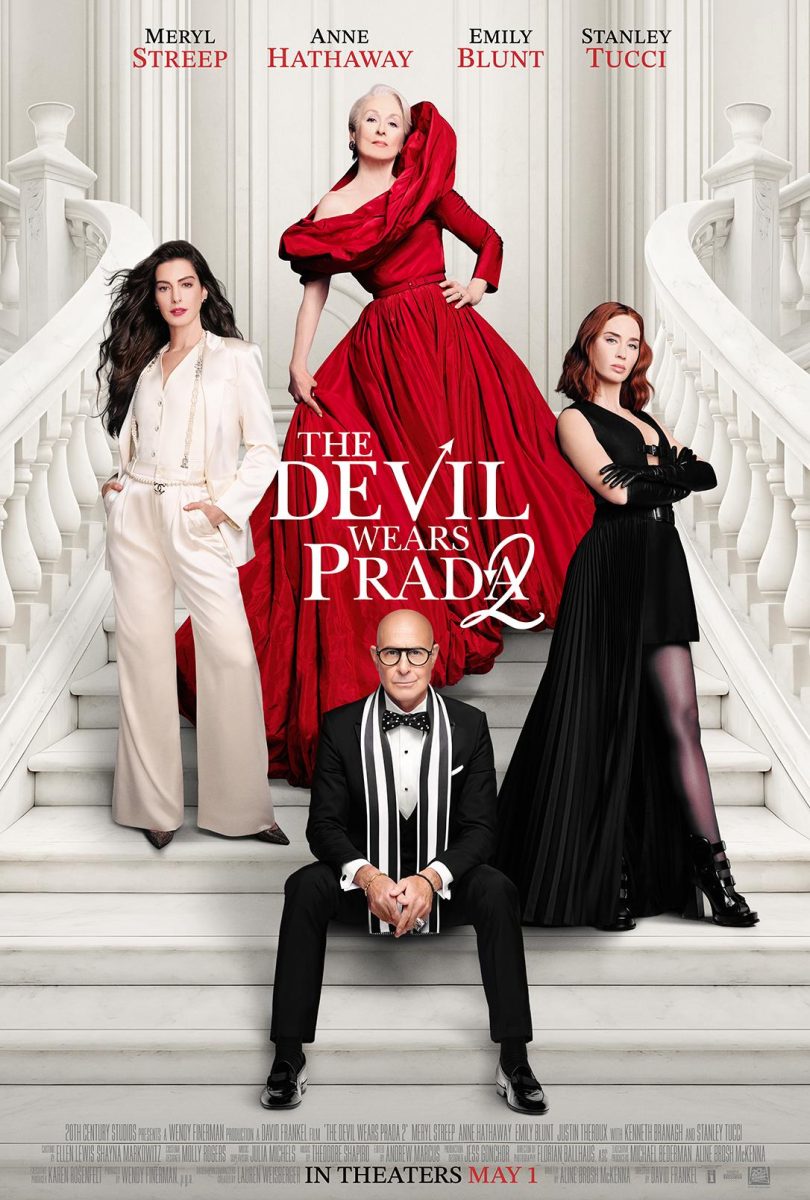
Fashion connoisseurs, film geeks, and the general public alike have waited nearly two decades for the highly anticipated sequel to The Devil Wears Prada (2006). Originally a book by Lauren Weisberger, the story was rumored to have been conceived in 2003 based on Weisberger’s own experience as the assistant to Anna Wintour–the editor-in-chief of Vogue magazine. As a movie praised for its sharp emotional and psychological performance and an era defining wardrobe, The Devil Wears Prada creates high expectations for its sequel. However, after nearly 20 years, The Devil Wears Prada 2 promises a new look at Runway and the modern era it now occupies. After premiering in New York on April 20th, The Devil Wears Prada 2 is set to be released in select theaters on May 1st, 2026.
The plot of The Devil Wears Prada 2 appears to center around Anne Hathaway’s character, Andy (Andrea) Sachs, returning to the fashion magazine Runway after her former boss, Meryl Streep’s character Miranda Priestly, gets wrapped up in a scandal. Taking place 20 years after the previous movie left off, beloved characters such as Stanley Tucci’s Nigel Kipling, and Emily Blunt’s Emily Charlton return. New additions include Miranda’s new First Assistant, Amari Mari, played by Simone Ashley, among others.
Although the first movie was a direct adaptation of the book, The Devil Wears Prada 2 is not an adaptation of the original sequel: Revenge Wears Prada. In the book, Andy forms a prosperous bridal magazine with her coworker from the previous movie, Emily Charlton. Taking place 10 instead of 20 years later, the pair must now reckon with Miranda’s pursuit of acquiring the bridal magazine for herself. The plot is a stark contrast to the movie, where Andy and Emily have stayed distant, and Miranda appears to have forgotten Andy even existed at all. The latter detail is particularly humorous, considering Anna Wintour herself claimed to have not remembered Lauren Weisberger after learning of the first book’s success.
Throughout the press tour, the cast made appearances in major cities such as Mexico City, Tokyo, Seoul, London and New York. Standout looks include Emily Blunt in Schiaparelli, Anne Hathaway in Louis Vuitton, and Meryl Streep’s many Prada overcoats. Both the movie and press tour sport a wide array of name brand designer clothing, and heavily feature major fashion houses and icons such as Donatella Versace and Dior. Not dissimilar to the first movie, it seems The Devil Wears Prada 2 aims to lend a marketing arm to the fashion industry, although now with much more support. The promotional trailer’s heavy emphasis on Miranda Priestley’s Valentino heels, may be an ode to Valentino Garavani’s appearance in The Devil Wears Prada as he was the only major designer to be publicly featured. In a striking turn of events, Anna Wintour features in Vogue alongside Meryl Streep, signaling her support and acceptance of the franchise’s success.
However anticipated the movie may be, it seems that one particular trailer has soured its perception. In a short clip released by 20th Century Studios, we are introduced to Andy Sachs’ new assistant, Jin Chao, played by Helen J. Shen. In the clip, Jin is introduced in a manner very stereotypically aligned with Asian female characters in Hollywood–that of high achieving excellence, but low social aptitude, as well as a potentially dislikable personality. This portrayal is frustrating, especially to many East-Asian fans of the first movie, and has sparked outrage in China, Japan, Korea, and Hong Kong. It’s important that conversations surrounding this movie properly address the issues raised by marginalized communities, and are critical of the potential racial, societal, and consumeristic implications of the ideas presented. Whether it is the strong impact on the inclusion and perception of fashion, or the expectancy simmering barely beneath the surface, it is unclear how the full movie will match up to people’s expectations. But it is clear that The Devil Wears Prada 2 and the original movie’s legacy has become not just a story, but a social phenomenon.